
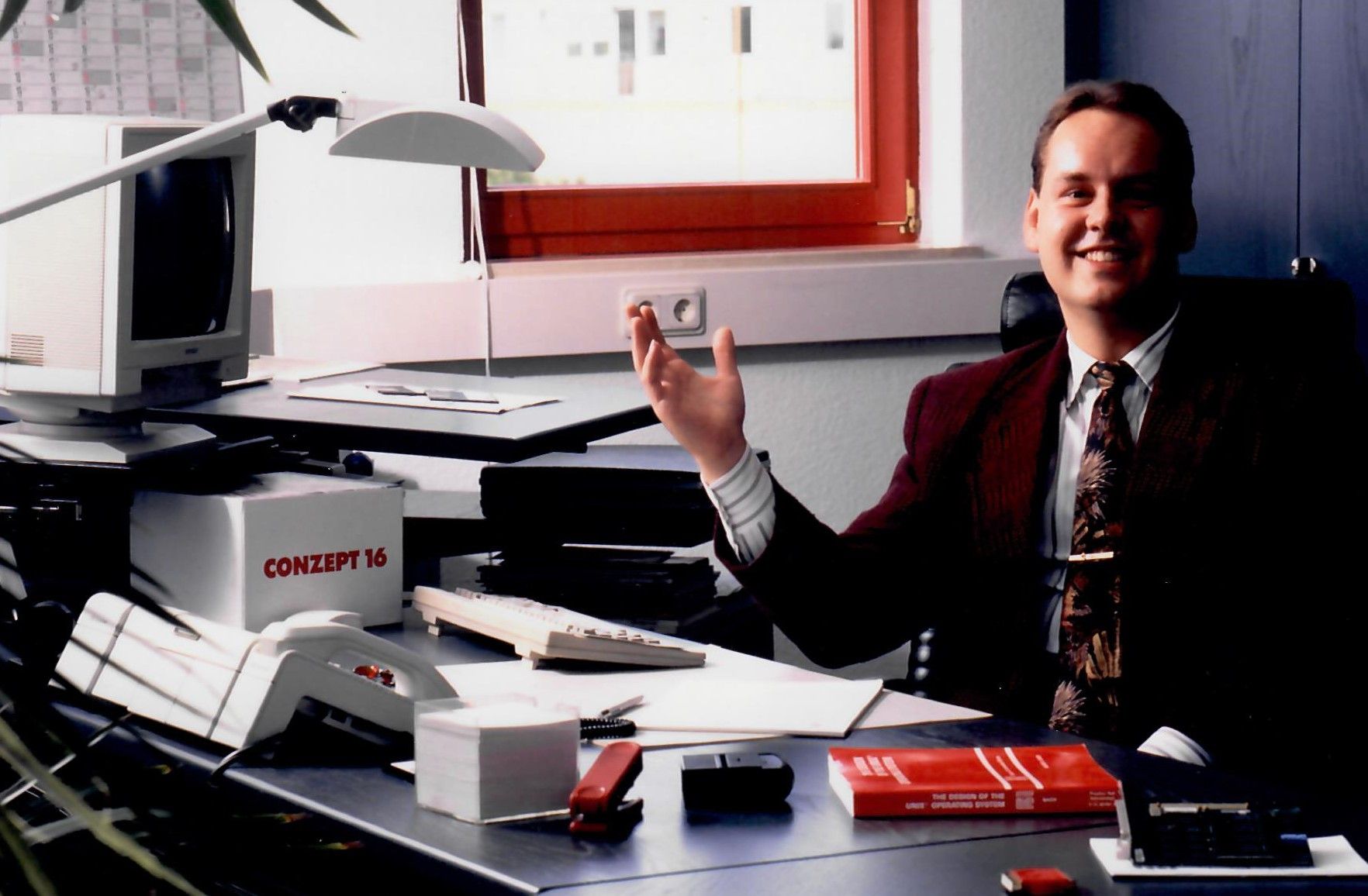
For more than four decades, conzept 16 has been supporting companies through technological upheavals, waves of digitalization and changes in the working world. Behind this extraordinary continuity stands the developer and founder of vectorsoft Andrej Mücke, who began programming solutions for real-world business processes as early as the 1980s.
We met with Andrej Mücke in January for an interview; here, he looks back with us on the early days of Vectorsoft AG. He discusses the challenges and technological turning points that have shaped his platform. At the same time, he shares his thoughts with us on the future of software development, balancing stability, design standards, and artificial intelligence.
The Beginning: How it all started
Mr. Mücke, take us back to the beginning: How did the idea for conzept 16 come about?
Our roots date back to 1982. At that time, I developed business software for office applications that had to run on early computers with very limited memory. The biggest challenge was managing file locations and dealing with the generally inconvenient working environment.
To solve this, two key components were developed: a file location library and a utility program for input and output operations. These program libraries formed the core of what would later become conzept 16.
As early as 1983, we made the system available to other companies. From then on, we received inquiries from all over Germany and even from Switzerland—and with each new request, the system continued to evolve into the first version of conzept 16.
The company’s early years
Was Vectorsoft a classic garage startup?
Not really. We were a small team of four people: two in sales, one colleague in support, and me as a developer. At first, we worked from home; later, we moved into an office in a back building. Then, in the late 1980s, our current company building was constructed.
What motivated you to start your own business?
The original founding of what was then known as vectorsoft GbR was simply necessary in order to serve our first client. A lawyer didn’t want to have software developed by a private individual — so we went ahead and founded a company. Although that specific project was never carried out, the company’s founding marked the starting point.
What skills from your youth have helped you?
I didn’t have any formal training in software development back then. I taught myself to program starting at age 16. Later, I studied software development while working. Looking back, the world was simply more manageable back then — but that’s exactly what made learning easier.
The founding of Vectorsoft AG
How did vectorsoft AG ultimately come into being, and who was part of the founding team?
The team included Edwin, among others, as well as our sales colleagues. I met Edwin through the computer manufacturer Wang Laboratories, where he was a product manager. That connection led him to vectorsoft. The sales staff joined later through various contacts.
What challenges did you face in the 1980s and 1990s?
Technically, it was difficult to access information — there was hardly any technical literature and, of course, no Internet. We worked with just a few books and American trade journals.
From an organizational standpoint, the question was how to structure software development as a team. We practically had to invent processes, collaboration methods, and version control all on our own.
Was there a moment where you thought the company would become big?
Honestly, no. My goal was always to solve specific problems. With each new version came new requirements, and we simply grew along with them.
The secret to conzept 16’s success
Many customers have been using conzept 16 for decades. What is the reason for this success?
Several factors come into play. First, compatibility: Applications created in the 1980s often still work today. Second, the stability of the software. And third, the close collaboration with our customers — they have always helped shape the development.
You could say that conzept 16 has grown alongside its users.
Which technological turning points were particularly influential?
The shift away from text-based systems toward graphical user interfaces was a major step. The transition from keyboard to mouse operation, as well as the development of the first database servers, also had a significant impact on the platform.
Was there any feedback that particularly changed conzept 16?
Yes—the introduction of its own programming language with procedures. This structure wasn’t present in early versions. It was only with this feature that it became possible to develop truly complex applications.
Market, Trends, and Technology
Which technological developments have surprised you?
In the past, software development was less trend-driven than it is today. The main focus was on solving specific problems.
Today, design plays a much bigger role. The upcoming facelift of conzept 16 is intended to show that the software is evolving and remains attractive to new employees. No one wants to work with a program that looks like it did 40 years ago.
How have customer expectations changed?
Of course, the demands have increased. At the same time, we’ve often had to proceed cautiously with further development due to compatibility issues. What matters most to us is that conzept 16 remains a living system.
What role does traditional software development play in the age of the cloud, AI, and low-code?
AI is currently primarily a tool that supports development. It will solve problems — but it will also create new ones. Traditional software development therefore remains central, but it will change significantly.
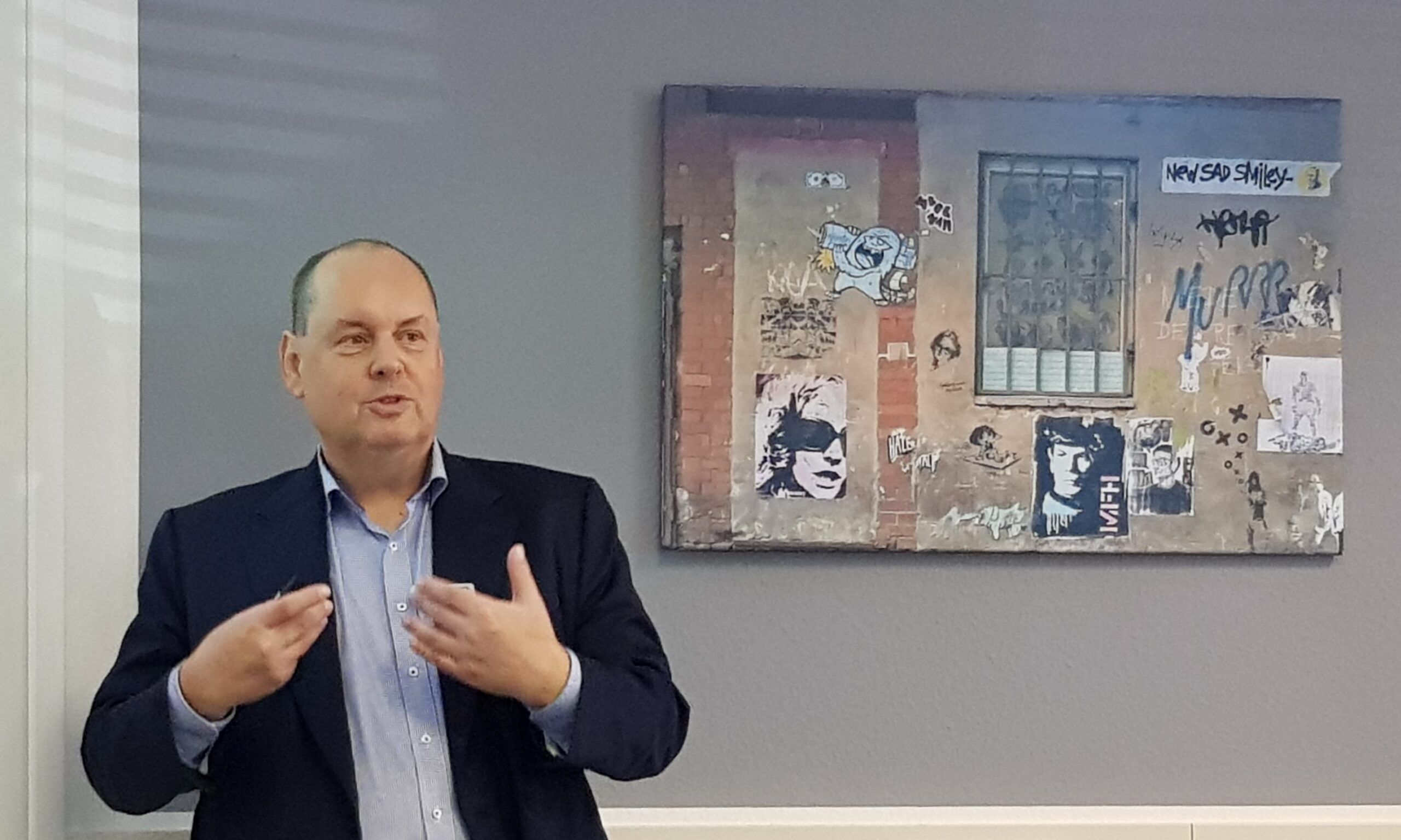 Andrej Mücke today
A Look into the future
Where do you see vectorsoft in ten years?
I hope that we can continue to successfully adapt to changing market conditions and keep evolving — just as we have done over the past decades.
If you could send a message to your younger self as a founder—what would it be?
To put it plainly:
Don’t be afraid to take risks.
In closing, we’d like to extend our heartfelt thanks to Andrej Mücke for the candid conversation, his personal insights, and the fascinating journey through four decades of software development.
His experiences impressively demonstrate how technical curiosity, a focus on the customer, and the courage to innovate can give rise to a long-lasting system and a successful company like vectorsoft AG.