

Vectorsoft AG, an established provider of development platforms with roots dating back to the 1970s, is setting new standards in software development with its low-code platform, yeet. As part of the AIDev research project, the company is seamlessly integrating artificial intelligence (AI) into the development process to help small and medium-sized enterprises (SMEs) address the shortage of skilled workers, meet compliance requirements and optimize costs. Of particular note is the close collaboration with the SME Competence Center for Usability, in partnership with the University of Kaiserslautern, which is optimizing yeet’s user experience (UUX) through funded reviews and pilot projects.
The yeet platform is based on vectorsoft’s many years of expertise; the company has long been a pioneer in database-driven application development, starting with the classic RAD system conzept 16 (developed beginning in 1979). Today, yeet combines an integrated database, UI builder, code editor, and deployment mechanisms in a browser-based environment—without additional tool silos. This eliminates the need for additional database and cloud layers as mandatory external components. Developers benefit from drag-and-drop functionality, pre-built building blocks, and automated code generation, which can reduce development time by a factor of five to ten. The development environment is platform-independent, supports both cloud and on-premises operations, and ensures GDPR-compliant hosting options in the EU, which minimizes lock-in risks.
Dr. Markus Pilz, CEO of Vectorsoft AG, emphasizes the strategic direction: “With yeet, we’re not starting from scratch—we’re building on what we’ve perfected over decades. The stability and close integration with the database, that conzept 16 was known for, remain the foundation. But on top of that, we’re now building a modern, AI-enabled, and cloud-ready platform that will reliably support our customers for the next 20 years.” The target audience includes SMEs as well as solo self-employed professionals, individual software developers, and small teams, as well as IT departments at larger companies that develop applications and industry solutions for areas such as finance, ERP, warehouse logistics, or customer service. In addition, yeet is also aimed at the public sector, which, in the context of digital sovereignty, places a high value on controllable, GDPR-compliant, and independently operable platforms.
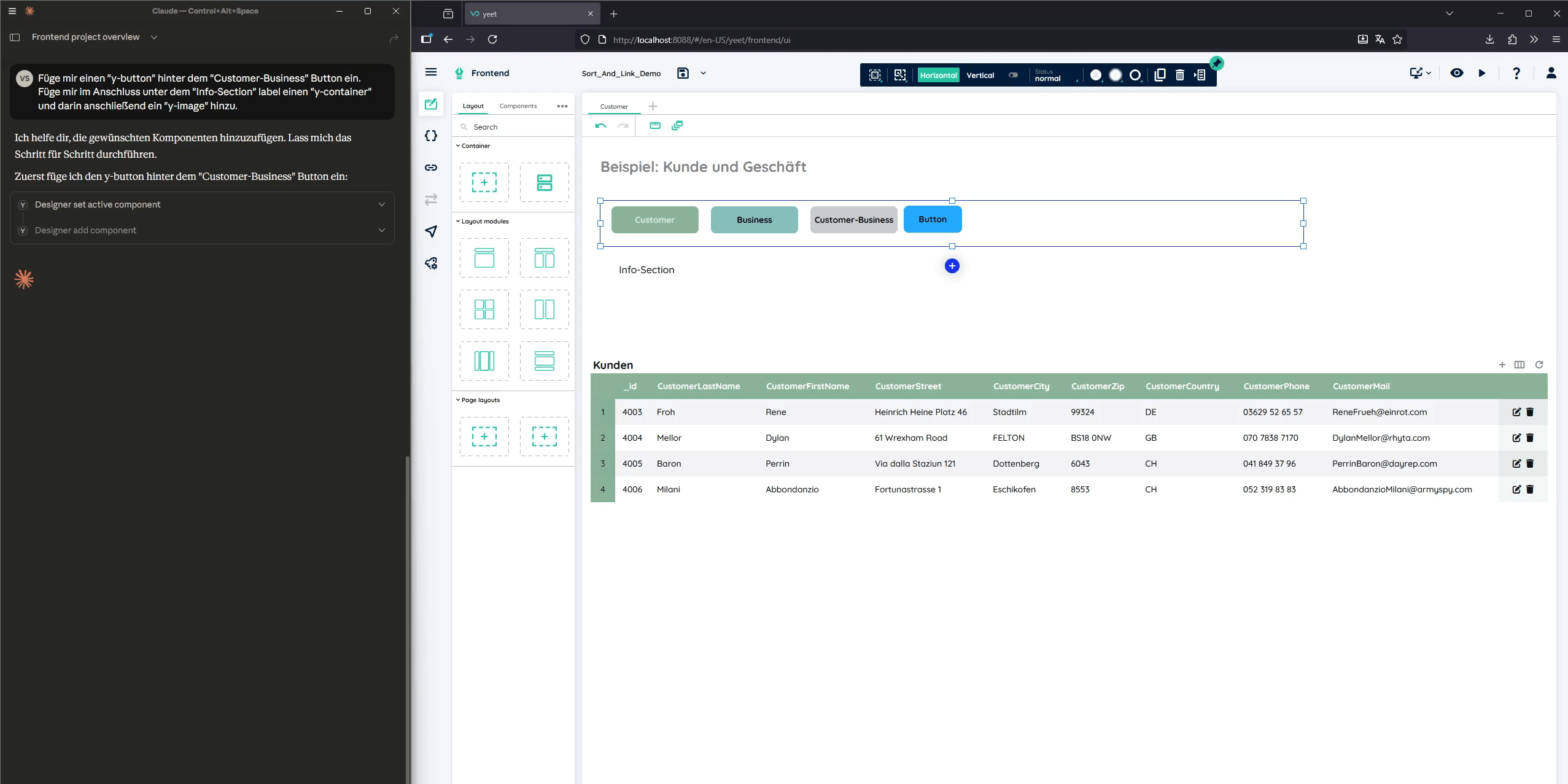
The AIDev research project, funded through the Federal Ministry of Finance’s (BMF) tax-based research funding program, positions AI not as a mere add-on, but as an embedded component. The AI analyzes project structures—including metadata, UI elements, and data models—and performs autonomous actions, such as adding UI elements or generating valid data sets. Miqueas Cramer, lead developer at vectorsoft, explains: “The AI reads the open project, particularly the metadata. It can then perform specific operations. Adding UI elements, inserting data, restructuring components.” This enables the secure and scalable development under the “Smart-Code” concept, which validates AI-generated code, adapts it to platform standards, and integrates it into a controlled environment.
In this way, Smart-Code deliberately distinguishes itself from “Vibe-Coding.” While Vibe-Coding often allows AI to iterate with maximum freedom and deliver quick results, risks related to reproducibility, testability, and security often only become apparent afterward. Smart-Code, on the other hand, relies on guidelines from the very beginning: clear rules, defined interfaces, traceable patterns, and integrated quality checks. The goal is not to slow down AI, but to make it reliably fast—with code that aligns with architectural, maintainability, and security requirements.
In the context of digital sovereignty, vectorsoft relies on a platform approach that can be consistently controlled: yeet can be operated on-premises and, if necessary, even in an air-gapped environment (without an external network connection). It also offers EU hosting options for GDPR-compliant deployments. Since yeet provides a unified development and runtime environment—including an integrated, in-house database—data management, permissions, updates, and deployments can be managed within a consistent environment, thereby reducing external dependencies. For integration with line-of-business applications and third-party systems, the platform officially supports OData and REST APIs, thereby creating standardized, traceable, and—among other things—multi-cloud-capable integration paths.
The collaboration with the SME Competence Center for Usability and the University of Kaiserslautern plays a central role in optimizing user interfaces. As part of a funded UUX pilot project, the usability of yeet was evaluated and improved to ensure intuitive operation for both professional developers and citizen developers. This collaboration underscores vectorsoft’s focus on research-based progress and addresses typical challenges faced by small and medium-sized enterprises, such as helping new employees get up to speed quickly and reducing administrative burdens. Furthermore, as part of the research project, Vectorsoft AG is collaborating with Hessian AI, the AI ecosystem of the Technical University of Darmstadt. The GPU infrastructure used in the project and access to a scientific AI network form a central foundation for the AI developments described here within the yeet platform.
yeet offers concrete benefits for businesses and public organizations: It alleviates the shortage of skilled workers by enabling junior developers to become productive more quickly with AI support, and minimizes risks—such as security vulnerabilities in generated code—through controlled embedding in Smart-Code. Use cases range from customer service apps for craft businesses to inventory management and digital questionnaires in the healthcare sector. The platform is designed to handle large volumes of data and enables seamless integration into existing system landscapes via open standards.
vectorsoft plans to further expand Smart-Code: Future features will include the generation of complete business logic, deeper workflow integrations, and trainable AI models within the EU platform. Dr. Pilz summarizes: “Smart-Code represents a development that is faster, more secure, and suitable for small and medium-sized businesses—without the risks of unchecked AI.”
For more information about the yeet platform and vectorsoft’s services, visit www.vectorsoft.de. Vectorsoft AG, headquartered in Heusenstamm, has been providing reliable solutions for data-intensive applications since 1985 and distinguishes itself through direct expert support with clear accountability all the way to the solution.